
Skip to main page content

AI has changed: what it means, and how to manage the disruption

Listen to the article:

Four questions for leaders

The four key questions for leaders are:

  1. What has changed in AI?
  2. What are the implications for organizations?
  3. What are the implications for leaders?
  4. How to best manage this disruption.

1. What has changed in AI?

Three shifts redefined AI recently
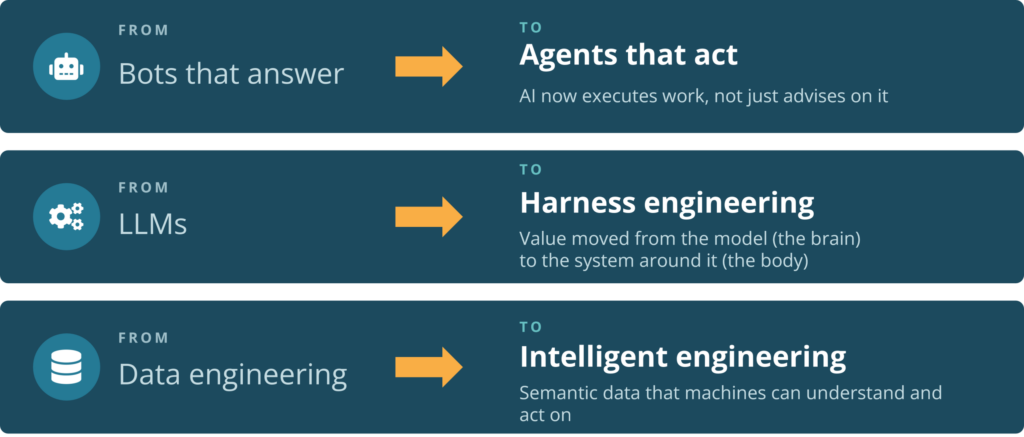
The “new” AI: it stopped waiting for you, keeps working
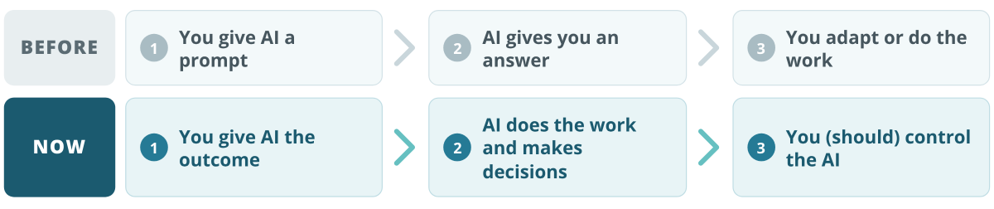
This is a game changer.

AI is ceasing to be software you use and becoming labor you direct: labor that can work faster, has more intelligence power than humans, is becoming cheaper every day and is improving itself every day.

However, for AI to work well for you, you have to explain very well what a good outcome is and what has to be done, which data to use, and what the guardrails are. You must define which decisions go to the machine and which remain human, monitor at all times, maintain ultimate human control, and adjust your business model and organization.

It is this process, beyond the AI technology you use, that is the real work of becoming AI-native. It is not just giving everybody access to AI. It is a transformation process that needs to be well structured and anchored in your business strategy.

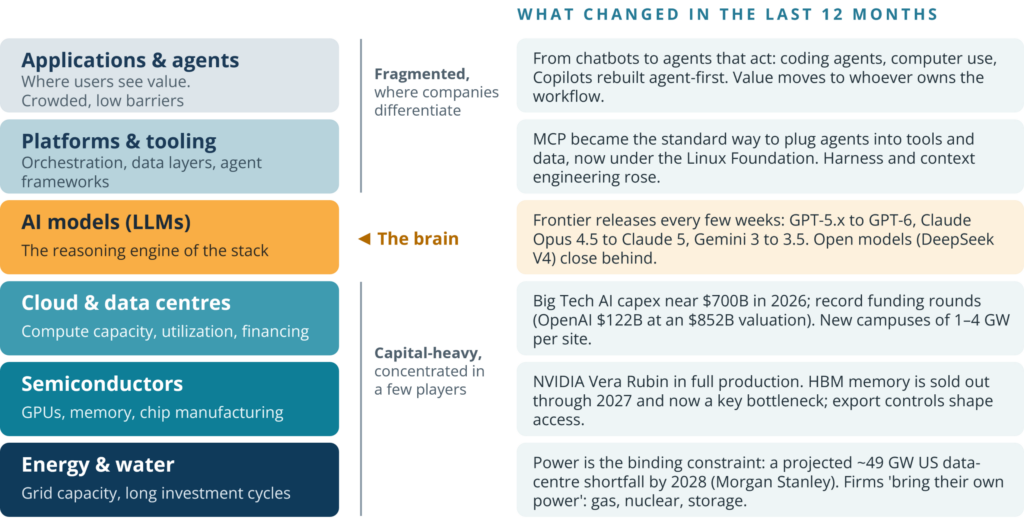
The supply side: six layers build AI capability, and all six moved this year
A new business model: agents change what is sold, and who buys

  • Far more computing. Agents use far more computing than chatbots.
  • From per user to per result. Pricing shifts from paying per user to paying per task or result.
  • Cheaper means more. Falling AI prices are likely to increase total use rather than reduce spending.

What changed in agentic AI

  1. Longer running work. The earlier emphasis was on short tasks and frequent handoffs. Progress over the year has brought more sustained work across sessions, with preserved task state, recovery after interruptions, and more systematic verification. From November 2025 to April 2026, new approaches emerged for long-running agents and managed execution. [1]
  2. Richer tool & media use. The earlier emphasis was on document retrieval and basic tool calls. Agents now actively inspect and act, with more efficient tool access, code execution across connected tools, and targeted video, audio and image inspection. From November 2025 to September 2026, the developments included advanced tool use and agentic video inspection. [2]
  3. Broader coding tasks. The earlier emphasis was on code suggestions and individual fixes. Progress over the year has enabled agents to build, test and refine larger features, including longer implementation tasks, iterative testing and debugging, and greater scope for internal software. A 2026 survey reports that 32% forwent at least one software purchase because coding agents enabled an internal build. [3]
  4. Wider, more controlled deployment. The earlier emphasis was on pilot projects and custom setups, including isolated pilots. Progress over the year has brought more scaled and managed deployments, with monitoring and observability, human approval for sensitive actions, managed execution environments, stronger sandboxing and permissions, and greater attention to running costs. Among large-company survey respondents, the share scaling agents rose from 27% in 2025 to 40% in 2026. [3, 4]

The shift is towards longer tasks, richer tool use, broader coding scope, and more operational deployment. Capabilities existed before this period; the change is their maturity and adoption. Progress remains uneven.

[1] Anthropic Engineering, November 2025–April 2026.
[2] Anthropic, November 2025; Google DeepMind, September 2026.
[3] McKinsey State of AI, August 2026.
[4] Anthropic Managed Agents, April–May 2026.

Six layers turn capability into value
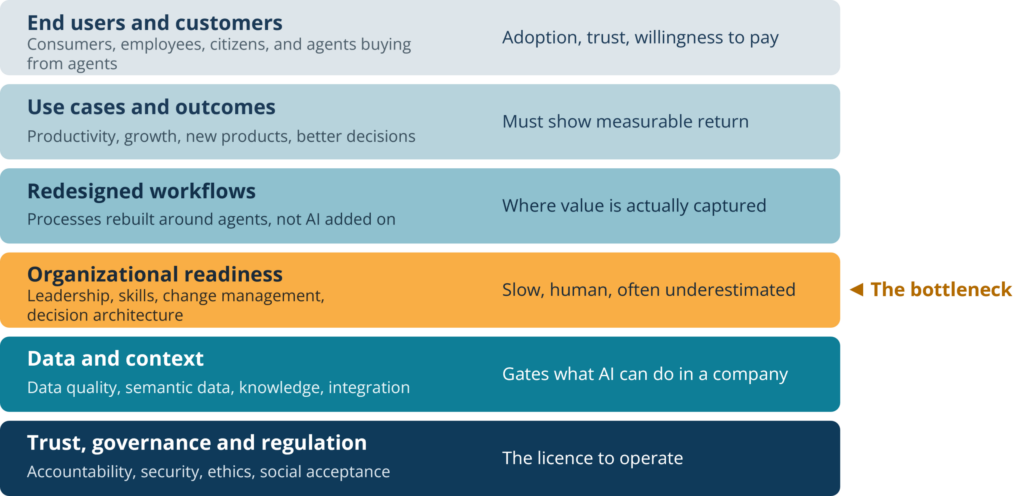
Capability is no longer the main constraint

What slows adoption is how fast organizations can absorb AI: redesign processes, retrain people and trust the results. AI is a leadership challenge.

Supply has the brain. Demand has the bottleneck

Supply is concentrated and capital-heavy, built by a few players with chips, power and data centres. Demand is fragmented and capability-heavy, created one organization and one workflow at a time. It depends on people, data and leadership more than on technology.

Four issues should be on top of the executive agenda

  1. Agent accountability. When an agent acts, who answers the outcome?
  2. Conversational interfaces and websites built for agents. Humans now ask instead of searching. Your next visitor, buyer or partner may be a machine.
  3. AI slop. Content is now cheap. Quality and trust are scarce.
  4. Overload, ROI and obsolescence. There are many new AI tools to use. Tools and skills now age in months, not years. How do I obtain real value from AI investments?

2. What are the implications for organizations?

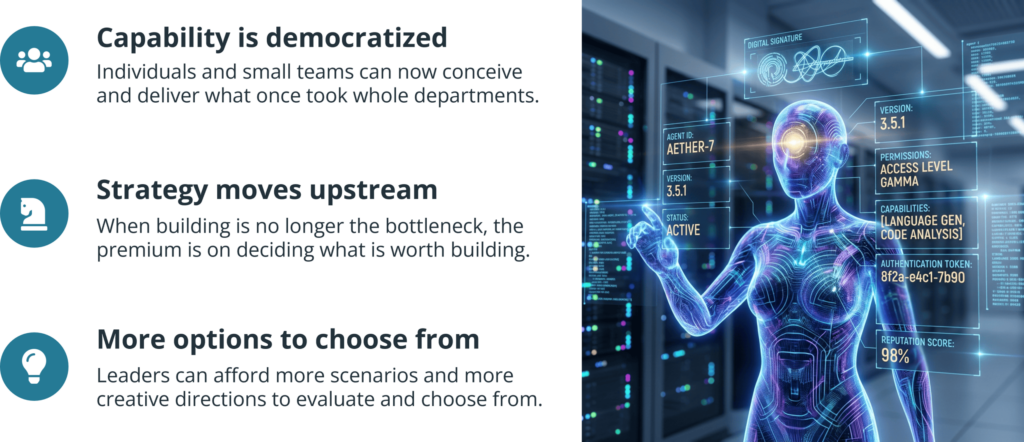
Intelligence & execution is becoming cheap. Judgment is becoming scarce

We are all moving toward the augmented organization.
Human judgement is the scarce resource

In the industrial age, scarce resources were physical assets and production capacity. In the digital age, scarce resources were software, data, and the speed of replication. In the age of AI, the scarce resource is discernment. Artificial intelligence is producing results at a speed faster than human intelligence can validate on its own. The capacity for judgment is scarce.

As a result, most people who use AI are making mistakes more quickly. Unsustainable experimentation and “sloppy AI” are proliferating in companies.

People are producing more at a faster pace, reaching conclusions that have never been thoroughly examined. In most cases, humans aren’t making decisions. They’re rubber-stamping an algorithmic result under time pressure and with incomplete information. They’re putting a human signature on it without giving it much thought.

Where to look for competitive advantage

Top models are table stakes. Advantage lies elsewhere.
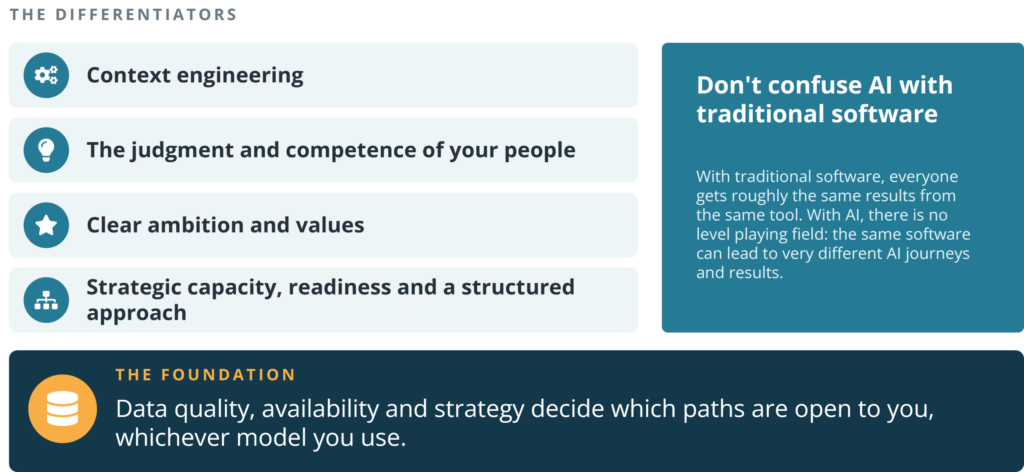
Four priorities for the organization
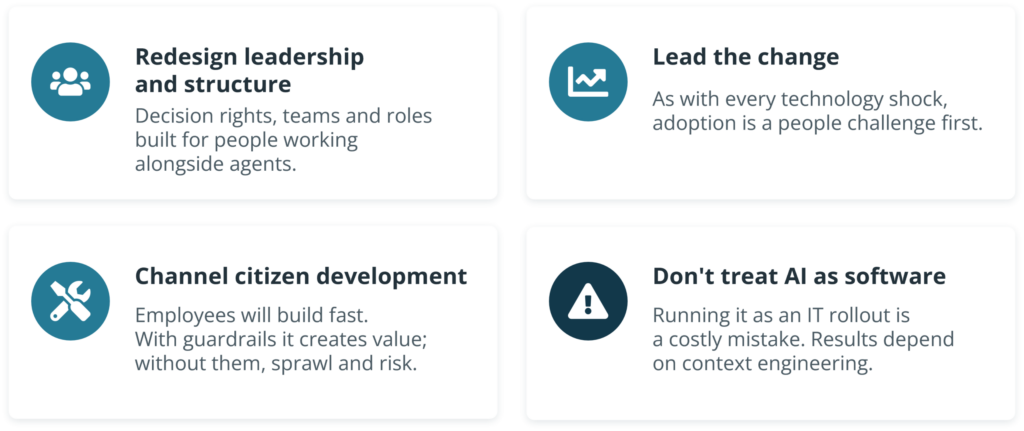
The new organizational structure: fewer layers, new building blocks
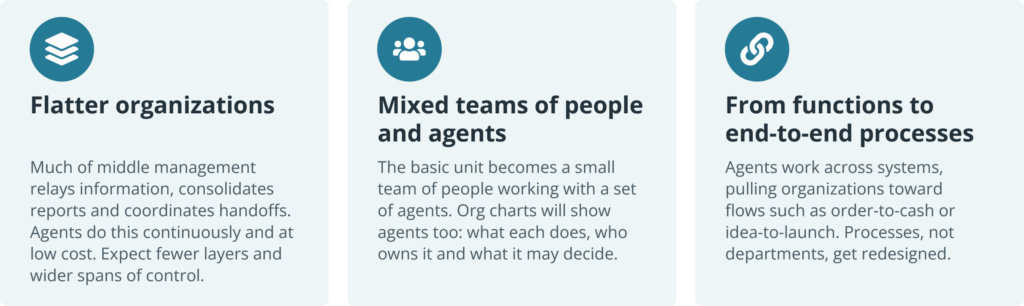
Smaller units, explicit control

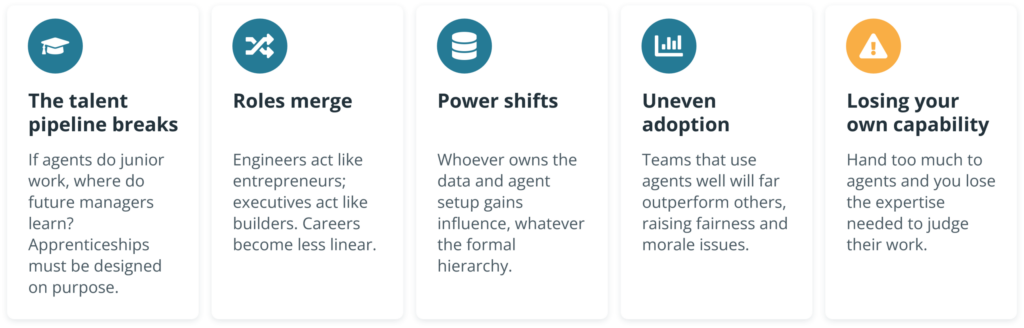
Smaller organizations at the same scale. A team of 10 to 20 people with strong agents could run what once needed hundreds. Big companies will be pushed to act like collections of small, autonomous units.

New control functions. These include agent governance, a person accountable for each agent’s results, and teams that own the context agents work from. Every agent action needs a human owner.

Decision rights written down. For each decision, state who decides: the agent decides alone, the agent recommends, or a person decides.

Five effects to watch
3. What are the implications for leaders?

AI is not a technical challenge. It is a leadership challenge

Leaders will evolve increasingly from decisionmakers to system designers of augmented organizations.

The companies that succeed with AI will not be those with the most advanced algorithms, but those with the strongest leadership alignment and the ability to turn AI into an everyday operational reality.

The focus is no longer having all the answers. It is now building organizations that learn and create value with AI faster than the competition.

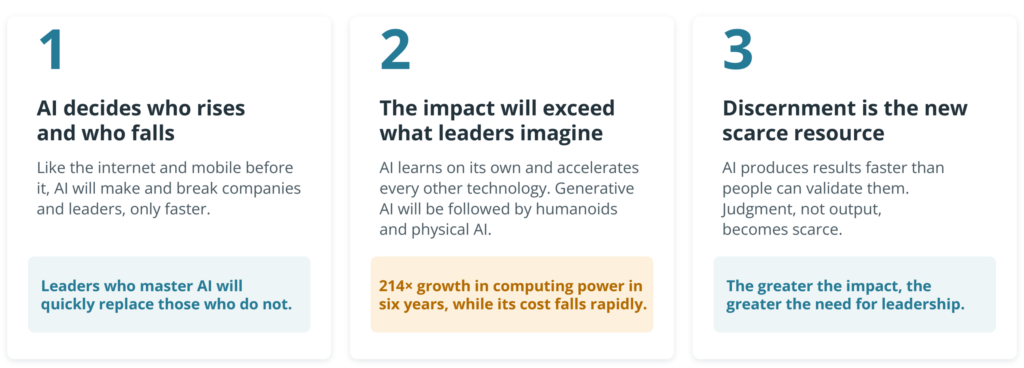
Three factors make the paradigm shift profound
AI scales the quality of your thinking and organization

Apply trivial or average thinking and get average thinking and results at scale. Apply structured, advanced thinking and get advanced thinking and results at scale.

From command to context, from decisionmakers to system designers

Traditionally, leaders were valued for making high-quality decisions and guiding people in a direction. In the age of agentic AI, success depends on designing systems that consistently make good decisions.

Leaders must redesign how decisions are made, who makes them and what data drives them. The question is no longer “What decision should I make?” but “How should this decision be made going forward?”. The choices are to automate, improve or keep human led.

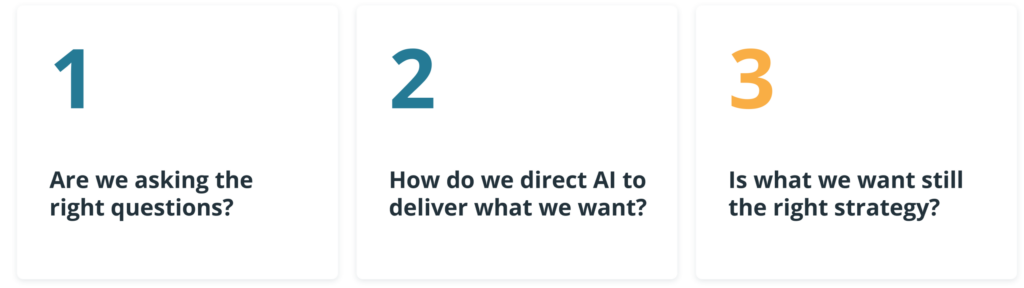
Leading with AI now means asking and directing
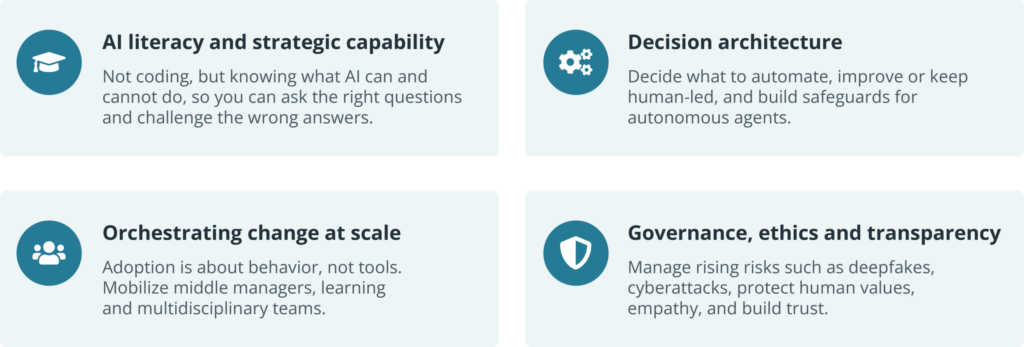
Every leader now needs four essential competencies
Top leadership: from deciding to designing

Designers of the system. The top team designs the system that decides: objectives, rules, data and safeguards.

Strategy is the bottleneck. Building is cheap. Clarity, values and stopping bad ideas early become the scarcest assets.

Strategy reviewed continuously. Rolling strategy replaces annual planning, without reacting to every signal.

Hands-on leaders. CEOs build prototypes themselves: closer to the work, but at risk of micromanaging.

New executive risks. These include liability for agents, errors at scale, cyber risk and boards asking where AI decides.

Culture and meaning. People look to leaders for purpose and fairness: who is retrained and how gains are shared.

Middle management is where the change is biggest: what fades, and what grows
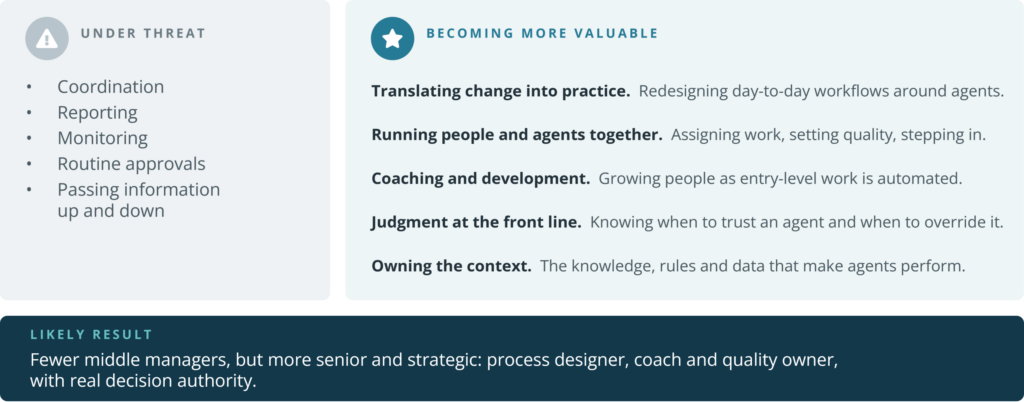
Roles are converging

Today’s AI engineer becomes a CEO running a team of agents. Today’s CEO or entrepreneur becomes a hands-on builder.

WHAT EFFECTIVE LEADERS DO

Six dimensions of effective leadership
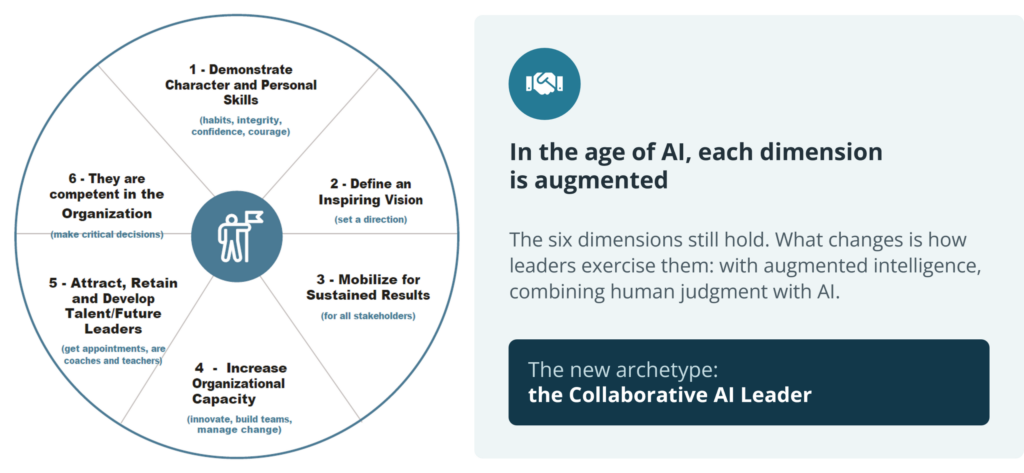
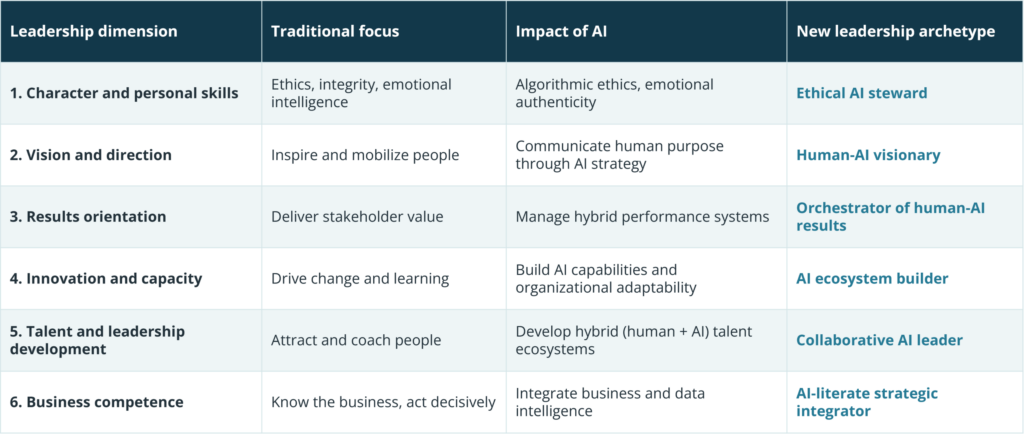
How AI changes each leadership dimension
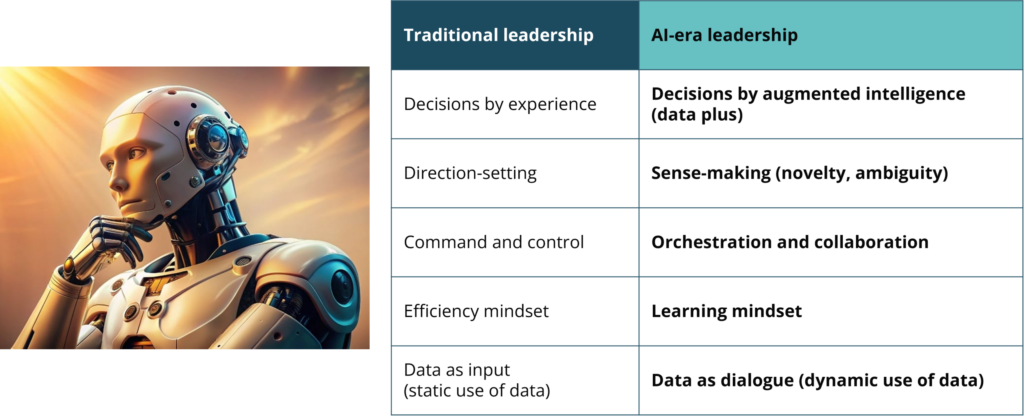
Which behaviors and assumptions you may need to change?
Almost anything can now be built.
Leadership is deciding what should be

4. How to best manage this disruption

Enterprise challenges: returns lag while technology races

The value gap: productivity is not profit. Gains are scattered: minutes saved per person rarely reach the P&L. Time saved becomes value only when work, roles and costs are redesigned. Costs are upfront and visible; returns are diffuse, delayed and often competed away.

Obsolescence: investments age in months. Models, tools and platforms leapfrog each other every few months. Today’s custom build can become tomorrow’s standard feature. Waiting is no answer: the cost of falling behind compounds.

What leaders can do is measure value in P&L terms, not hours saved; redesign workflows to bank the gains; build modular, model-agnostic architecture; and invest in what lasts: data, context and people.

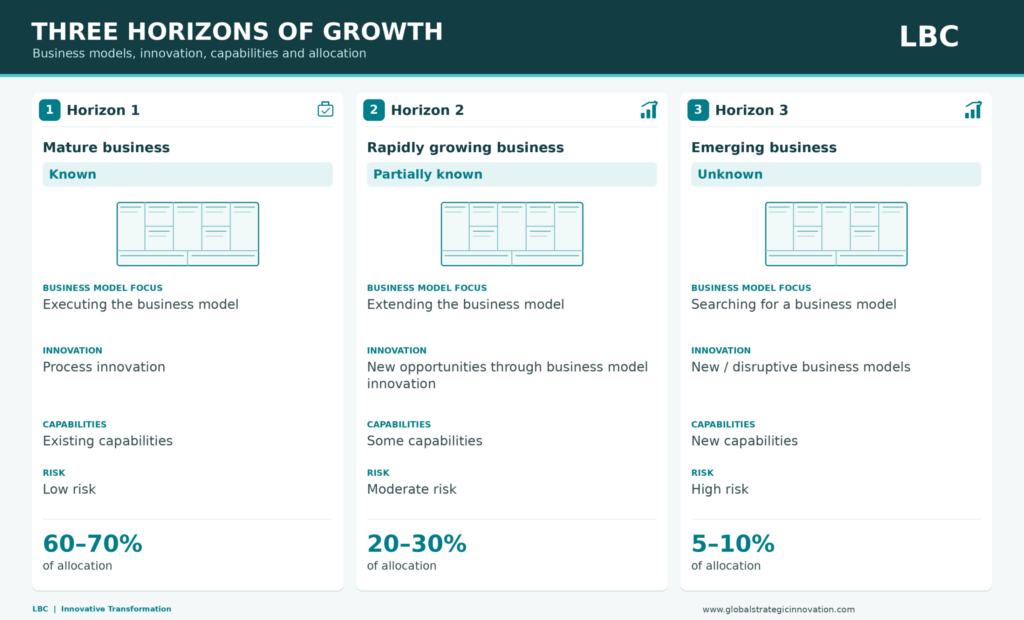
You need an innovation framework, such as Three Horizons of Growth

The Three Horizons of Growth framework covers business models, innovation, capabilities and allocation.

Horizon 1: Mature business – known. The business model focus is executing the business model. Innovation is process innovation, using existing capabilities and involving low risk. Allocation is 60–70%.

Horizon 2: Rapidly growing business – partially known. The business model focus is extending the business model. Innovation creates new opportunities through business model innovation, with some capabilities and moderate risk. Allocation is 20–30%.

Horizon 3: Emerging business – unknown. The business model focus is searching for a business model. Innovation concerns new or disruptive business models, requiring new capabilities and involving high risk. Allocation is 5–10%.
LBC | Innovative Transformation. www.globalstrategicinnovation.com

AI STRATEGY ROADMAP

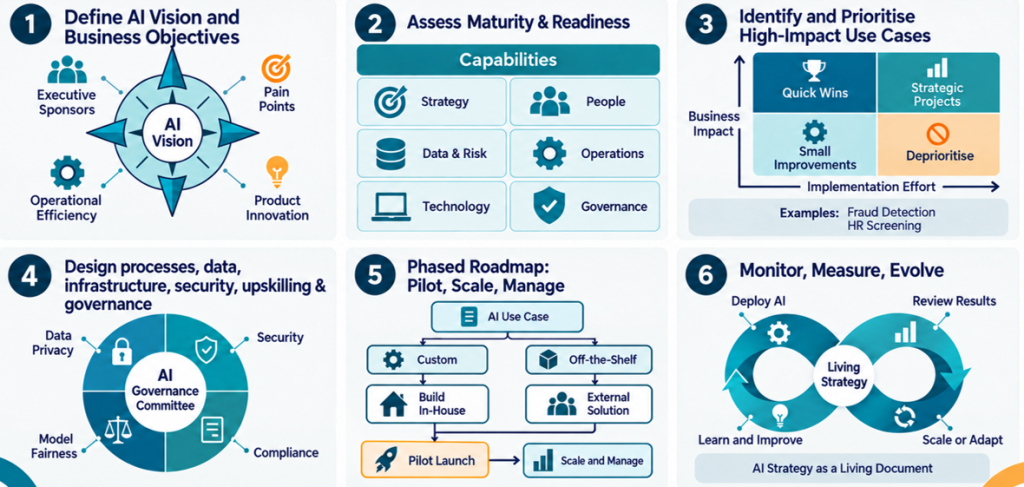
You need a structured strategy and roadmap to aim at exponential growth

  1. Define AI vision and business objectives. Establish the AI vision in relation to executive sponsors, pain points, operational efficiency and product innovation.
  2. Assess maturity & readiness. Assess six capabilities: strategy, people, data & risk, operations, technology and governance.
  3. Identify and prioritize high-impact use cases. Assess business impact against implementation effort. High-impact, lower-effort initiatives are quick wins; high-impact, higher-effort initiatives are strategic projects. Lower-impact, lower-effort initiatives are small improvements; lower-impact, higher-effort initiatives should be deprioritized. Examples include fraud detection and HR screening.
  4. Design processes, data, infrastructure, security, upskilling & governance. The AI Governance Committee covers data privacy, security, model fairness and compliance.
  5. Phased roadmap: pilot, scale, manage. For an AI use case, consider a custom solution built in-house or an off-the-shelf external solution. Move through pilot launch, then scale and manage.
  6. Monitor, measure, evolve. Maintain a living strategy through a cycle of deploying AI, reviewing results, scaling or adapting, and learning and improving. Treat AI strategy as a living document.
Five moves leaders need to make now

  1. Map key decisions. Assign each to an agent, agent plus person, or person only.
  2. Pilot one end-to-end process. Redesign it around agents, rather than adding agents to old tasks.
  3. Redefine the middle manager role. Train managers first: they carry the change.
  4. Set up agent governance early. Create an inventory of agents, a human owner for each, permissions and audits.
  5. Protect learning paths. Keep developing junior talent deliberately.

AI does not lead. People lead

Build augmented organizations that create exponential value with AI, where AI is the assistant and people are in control.
info@lbc-global.com
aileap@lbc-global.com

Click here to know more or book a metting.

Leadership in the age of AI

Artificial Intelligence is a leadership challenge.

The lessons learned from immersion programs in Silicon Valley and from real-world business experience lead us to conclude that the companies that will succeed in the age of artificial intelligence (AI) will not be those with the most advanced algorithms, but those with the strongest leadership alignment and the ability to turn AI into an everyday operational reality.

In the era of artificial intelligence, leadership no longer consists of having all the answers. It consists of building organizations that learn and generate business value with AI faster than the competition.

The biggest misconception an executive can have is to think that AI is a technical challenge. It isn’t. It’s a leadership challenge.

1. The core of leadership in the age of AI.

The core of leadership in the AI era is the management of the interfaces between human intelligence and artificial intelligence—and the limits of both.

The central role of business leaders is no longer simply to set strategy and allocate resources. In the age of AI, leaders must become architects of augmented organizations and companies where human judgment and artificial intelligence combine to drive better, faster, and more scalable decisions and operations.

Factor 1 | The Potential of AI = The Rise and Fall of Leaders and Companies

Major technological shifts have defined the rise and fall of companies. The birth of the Internet and mobile technologies, just 40 years ago, turned digital companies into the largest and most powerful in the world. Companies like Alphabet, Amazon, Apple, Meta, and Microsoft have achieved market capitalizations in the tens of billions of dollars.

Similarly, AI will determine the rapid rise and fall of businesses, companies, and leaders at all levels.

However, the speed at which AI is developing calls into question the ability of organizations, and the business world in particular, to adapt in a timely manner. The changes in the business world will be more profound and much faster than in previous technological transitions. The effect of Schumpeter’s creative destruction will be far stronger.

Leaders who master AI will quickly replace those who do not.

Factor 2 | AI will have a much greater impact than today's leaders imagine.

AI will impact the world more rapidly and more profoundly than any previous technological revolution because:

  1. it is the first technology that learns on its own, improving at an exponential rate,
  2. it accelerates other technologies in a synergistic way. The investments made by key players are unprecedented.

Computing power has increased 214-fold in 6 years, and its cost is falling rapidly.

The cost of intelligence is falling rapidly and becoming more accessible

AI is in its infancy. What we will see in the future is far more advanced than what we are witnessing now. The current wave of generative intelligence, which surprises us every week, will be followed by a wave of widespread commercialization of humanoids and physical AI.

The development and application of Artificial Intelligence will lead to a reshaping of our society. The impacts that will occur, both positive and negative, are far greater than what leaders and society currently imagine.

The greater the impact, the greater the need for leadership.

Factor 3 | Discernment is the new scarce resource

In the industrial age, scarce resources were physical assets and production capacity. In the digital age, scarce resources were software, data, and the speed of replication. In the age of AI, the scarce resource is discernment. Artificial intelligence is producing results at a speed faster than human intelligence can validate on its own. The capacity for judgment is scarce.

As a result, most people who use AI are making mistakes more quickly.

Unsustainable experimentation and “sloppy AI” are proliferating in companies.

People are producing more at a faster pace, reaching conclusions that have never been thoroughly examined. In most cases, humans aren’t making a decision. They’re rubber-stamping an algorithmic result under time pressure and with incomplete information. They’re putting a human signature on it without giving it much thought.

With digital applications, performance variation among users wasn’t significant. With artificial intelligence applications, the performance variation resulting from a single application is enormous. If we apply trivial or average thinking to a model, we’ll get trivial or average thinking at scale. If we apply structured and advanced thinking to a model, we’ll get advanced thinking at scale.

2. Business leaders in the age of AI: from decision-makers to systems designers

Traditionally, leaders were valued for making high-quality decisions and guiding people in a certain direction.

In the age of AI, a leader’s success and impact depend on designing systems that consistently make good decisions

Leaders need to redesign how decisions are made, who makes them, and what data drives them, combining ethics and human aspirations with intelligent systems.

Disruptive and sustainable competitive value exists only when leaders ensure that data flows, feedback loops, and algorithms are aligned with business objectives, updating the operational model and people’s roles within the company.

The focus shifts from “command” to “context”.

The main challenge is who makes the decisions and maintains control.

3. Four new leadership skills are becoming essential.

i) AI literacy (not expertise) and strategic capacity

Leaders don’t need to code, but they must understand what AI can and cannot do. This includes understanding the strategic and operational potential within their business and the risks of AI, as well as concepts such as model bias, data quality, and the limits of automation. Without this, they cannot ask the right questions—nor challenge the wrong answers.

ii) Decision architecture

The key question is no longer “What decision should I make?” but rather “How should this decision be made going forward?” Leaders must encourage data-driven decisions and identify which decisions and operations can be automated, improved, or should continue to be led by humans, and redesign processes and responsibilities accordingly. The deployment of agents granted with autonomous powers to learn, plan, decide, and act makes this capability even more urgent. The ability to build safeguards for the behavior of powerful autonomous models is critical.

iii) Orchestrating change at scale

The productive adoption of AI has less to do with tools and more to do with behavior. Resistance will not come from technology, but from people. Leaders must train and mobilize middle managers for AI, as they are best positioned to bridge the gap between business understanding and operational implementation. Actively promote training and self-directed learning in AI, a culture open to AI, and the creation of multidisciplinary teams

iv) Governance, ethics and transparency

The risks of AI increase with its development and widespread adoption in society. Additionally, deepfakes are becoming increasingly sophisticated. Cybersecurity risks are on the rise, especially those related to personal data and distortions in perceptions of people. Therefore, establishing appropriate governance for AI systems is essential.

AI excels in speed, scalability, memory, and prediction, but it lacks empathy unless this is built into the model. Leaders in the AI era must be protectors and promoters of human and ethical values, ensuring the necessary empathy for people’s concerns and aspirations.

It is increasingly difficult to discern what is produced by people and what is produced by artificial intelligence applications. Transparency is essential to building trust and acceptance of augmented production.

Artificial intelligence doesn’t lead. People lead.

Leaders must build augmented organizations aimed at exponential value creation through the power of AI, but where AI is the assistant and people are in control.

Carlos Valleré Oliveira é fundador e CEO da LBC

Carlos Valleré Oliveira is the founder and CEO of LBC – Intelligent Transformation, with over 1.200 projects in 18 countries, and strategic coordinator of the GSI AI Frontier executive immersion program in Silicon Valley. He holds an MBA from the New University of Lisbon and has completed AI courses at the Berkeley Haas School of Business and Imperial College London.

LBC is an international strategic consulting and digital transformation firm with experience in 18 countries and an innovation lab in Silicon Valley.

LBC can provide guidance to executives challenged by the pace of rapid transformation and support the implementation of digital transformation.

Please contact us at info@lbc-global.com for assistance.

LBC is a registered trademark of Leadership Business Consulting SA.

Dare to be Innovative  
Embrace Transformation  
and Deliver a better world 

Digital sovereignty in Angola

Angola can strengthen control over its digital assets and turn that control into better services, talent, and economic activity. The path forward combines protection proportional to risk, international cooperation, and local implementation capacity.

This insight is intended for public-sector decision-makers, business leaders, and development partners. It contributes to the discussion of the central issues in the digital transformation of the information society and presents an implementation agenda for Angola.

LBC CEO, Carlos Valleré Oliveira, was a guest speaker at ANGOTIC 2026, held in Luanda from June 11 to 13, on the panel “Soberania Digital e Transformação Digital da Sociedade da Informação” (Digital Sovereignty and Digital Transformation of the Information Society). This article, along with another on the digital transformation of the information society in Angola, formed the basis of his contribution. Both are contributions to the discussion.

Continue reading in Portuguese ou English.

20 years contributing to the development of Angola

Grupo de angolanos que trabalham juntos

The story of LBC’s 20 years in Angola, beginning in 2005, reflects our professional ethos, grounded in four guiding principles, with the aim of delivering extraordinary results for our clients, built on very strong professional values.  

It is also a story focused on the development of Angola, which we have accompanied through our office in Luanda a registered company with a local team since 2006. We have selected 20 of the more than 300 projects carried out over these 20 years, to illustrate LBC’s professional contribution to the country’s development.

The highest levels of international quality

In Angola, LBC’s professional ethos was shaped from the outset by the clear guidance given in 2005 by the company’s founder and managing partner, Carlos Valleré Oliveira: “In each and every deliverable to the client, we must apply the highest international quality standards, even when this is not required by the client.” Internally, this commitment is illustrated by two cases from LBC’s first year in Angola, when work was redone despite having already been formally accepted by the client, because a final review found that it did not yet meet the company’s quality standards.

In each and every deliverable to the client, we must apply the highest international quality standards, even when this is not required by the client.

This guidance came alongside another, related to the very purpose of LBC’s existence: to be “a catalyst that contributes to greater economic efficiency, better public services, greater social well-being and a healthier environment”. In this way, beyond the business rationale, we frame our activity within a broader perspective of social and economic responsibility. “We are enzymes that accelerate progress and well-being, helping the public sector and companies to raise their performance levels, respectively in the service of citizens and in the service of clients”. In the case of Angola, with its enormous and pressing socio-economic development challenges, this purpose and responsibility are heightened.

In this context, our measure of success is the impact we have on our clients. And we take pride in the work done for the development of Angola over these 20 years. We also feel privileged and grateful that Angolan public and private decision-makers have continuously entrusted LBC with their challenges in more than 300 projects already carried out across almost every area.

Read the full article (PT)

Read the full article (EN)

The Lisbon MBA and LBC – a partnership of excellence for the training of global leaders 

Uma parceria de excelência

LBC – a leader in transformative innovation, which combines strategy, digital transformation and talent development to increase the performance of organizations – has been running the Leadership Challenge for The Lisbon MBA Católica|Nova since 2012.

This MBA – a partnership between two of the leading European business schools, CATÓLICA-LISBON and Nova SBE, in collaboration with MIT Sloan (USA) – is a leader in Portugal and 25th in Europe, according to the “Financial Times”; and 19th among the best in the world in the “Joint Programmes” category in the QS Executive MBA 2024 ranking.

O dleadership challenge  

The Leadership Challenge provides an annual transformative experience that culminates in a trip to the epicenter of global innovation: Silicon Valley, USA. This is where the best leaders test not only their knowledge, but also their leadership skills – from solving complex problems to their ability to lead in disruptive innovation environments.

During the Leadership Challenge, five students are chosen as finalists by their peers based on the leadership skills they demonstrated during their MBA. In the next phase, these five finalists lead five teams in a dynamic, four-hour, real-time hostage rescue leadership exercise, which takes place at LBC’s Lisbon office.

In the next phase, three finalists have the opportunity to demonstrate their abilities before a renowned jury. Each candidate must convince the jury of their capacity to lead teams, make decisions in complex contexts, and anticipate the future in a constantly transforming business world, through a 15-minute presentation and a question-and-answer session. The winner of the Leadership Challenge 2024 is Ana Neto, as announced during the graduation ceremony at the end of the year.

Silicon Valley Immersion Experience

Ana Neto will join the “AI Frontier” innovation program at GSI – Global Strategic Innovation in Silicon Valley, a destination that symbolizes both the completion of an excellent academic path and the beginning of a career with potential for global impact.

Leadership excellence transcends academic development. LBC has been a key strategic partner of The Lisbon MBA, providing students with an immersive perspective on the challenges of a disruptive future. This collaboration reflects LBC’s commitment to excellence and its determination to shape a new generation of global leaders.

Visit GSI – Global Strategic Innovation program website.

GSI AI Frontier – The Future of AI in Silicon Valley

Bay area in Silicon Valley

The 53rd edition of the Global Strategic Innovation – International Executive Program, dedicated to innovation and leadership for executives, will take place in the Bay Area, USA, from October 20 to 24, 2025. This year’s immersion program, called GSI AI Frontier, has a cross-cutting theme of artificial intelligence (AI). GSI AI Frontier will provide a complete immersion into the innovative and entrepreneurial culture in Silicon Valley, with key players leading the AI ​​revolution, providing the tools and inspiration to lead the digital transformation in your organization. 

What makes GSI AI Frontier unique?

During five intensive days, participants have access to an exclusive program carefully designed for complete immersion:

  • Interactive sessions for real challenges. Each day begins with a session led by LBC, where experts and external guests create a strategic framework for the program. The first session focuses on identifying a real challenge each participant faces, and by the last session, it is expected that a concrete, actionable solution will be presented.
  • Accelerate innovation with hands-on workshops. The program provides a deep understanding of the impact of technologies such as AI. These sessions will help you define a framework for accelerating innovation processes, focusing on tools such as design thinking and pretotyping, challenging the status quo and leading digital transformation efforts in your organizations.
  • Exclusive visits and sessions with leading players. Participants have the opportunity to interact directly with leaders of disruptive companies, who share best practices and lessons learned in transforming their businesses, whether in creating business opportunities or restructuring traditional models.
  • Visit to incubators and start-ups. Participants will also visit several recognized incubators and accelerators, where they will have the opportunity to learn about their working methods, and also receive presentations from start-ups aligned with their interests.
  • High level networking. Throughout the program, participants will have exclusive access to networking sessions with entrepreneurs from Silicon Valley and other parts of the world, providing a unique opportunity to expand their network of contacts and establish valuable connections that can drive new business opportunities.

In a world where AI is at the forefront of strategic business and government decisions, it’s crucial that leaders are ready to act. GSI AI Frontier will provide deep insights and practical methodologies on the future of AI, preparing you to take a leadership role in this transformation.  

Learn how to participate in the program and increase your knowledge in AI on the page GSI AI Frontier.

Interactive “Porter Report” supported by generative artificial intelligence

Relatório Porter interativo em IA

In 1992, the Minister of Industry and Energy, Eng. Mira Amaral, in collaboration with several business associations and companies, which financed the project, commissioned a study led by Professor Michael Porter, to apply his competitive analysis models to the Portuguese economy . 

The result came in 1994, with the report “Building the Competitive Advantages of Portugal”, commonly known as the “Porter Report”, which proposed a concrete path of action to make Portugal more competitive.  

The report remains an indispensable compass for the contemporary challenges of competitiveness, with the think tank “Sharing Knowledge”, coordinated by Eng.º Jaime Quesado, having recently dedicated several sessions to reflecting on the relevance of the report today. 

Noting that there was no digital copy of the report online, and only a rare number of paper copies, Eng. Mira Amaral decided to arrange for its digitalization, with the consent of the Competitiveness Forum, the document’s publisher.  

It was in this context that LBC offered to apply generative artificial intelligence to the report. 

By enabling interactive analysis of content and the immediate production of objective responses to the reader’s free questions, generative artificial intelligence opens up new horizons for exploring the strategies proposed by Michael Porter. 

The interactive “Porter Report”, powered by generative artificial intelligence, is therefore more than just a simple rendering of an economic classic. By enabling a more in-depth and interactive analysis of the content, this tool allows for a more powerful exploration of the strategies proposed by Michael Porter, in light of the complex issues that shape Portugal’s economic future. 

In response to the reader’s specific questions, the ability to immediately produce answers based on the “Porter Report”, provided by generative artificial intelligence, means that this document continues to be a relevant compass for the contemporary challenges of competitiveness in Portugal and a vital source of action strategies. 

Access the interactive “Porter Report” using this link. 

What will energy be like in the future?

Ponte de São Francisco em Silicon Valley

The Bay Area ecosystem (Silicon Valley and San Francisco), USA, is a world leader in seeking and building disruptive innovation waves that generate global business opportunities and economic and social progress. GSI – Global Strategic Innovation, through customized immersion programs in the Bay Area, has maximized and accelerated the return of executives on innovation in their organizations and in their personal development.  

With 42 editions to date, GSI connects executives, entrepreneurs, public decision-makers and academics from around the world with experts, start-ups and “champion” companies from the Bay Area, with a dual perspective of learning and business. 

GSI Energy & Sustainability

O GSI Energy & Sustainability, taking place from October 21st to 25th, developed in partnership with ADENE – Energy Agency, provides in-depth insights into current energy issues and future sustainable solutions. This program engages participants in innovative thinking and hands-on learning, introducing cutting-edge ideas, solutions and technologies to transform and strengthen their business, reinforcing them as leaders and agents of change. It will also compare the European model with the American model. Highlights of the program include: 

  • The future of energy; 
  • Artificial intelligence in energy; 
  • The challenge and solutions of decarbonization; 
  • The challenge of sustainability. 

Among others, participants will have access to: 

  • Insights into future challenges and trends in energy and sustainability;
  • Participation in workshops and practical projects on sustainable energy solutions;
  • Networking with global professionals and industry leaders;
  • Development of strategies to integrate sustainability into business and public policies. 

Registrations until October 11th.  

GSI has open programs (free registration, as long as you meet the qualification requirements) and closed programs (registration decided by the company or contracting entity). Find out more at GSI.