


Four questions for leaders
The four key questions for leaders are:
- What has changed in AI?
- What are the implications for organizations?
- What are the implications for leaders?
- How to best manage this disruption.
1. What has changed in AI?
Three shifts redefined AI recently
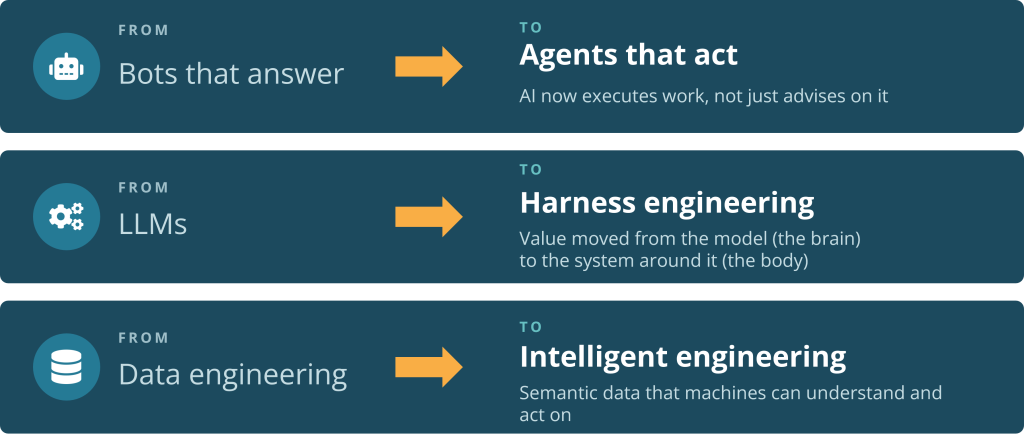
The “new” AI: it stopped waiting for you, keeps working
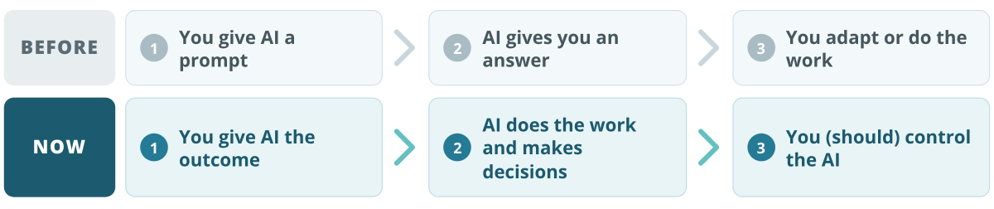
This is a game changer.
AI is ceasing to be software you use and becoming labor you direct: labor that can work faster, has more intelligence power than humans, is becoming cheaper every day and is improving itself every day.
However, for AI to work well for you, you have to explain very well what a good outcome is and what has to be done, which data to use, and what the guardrails are. You must define which decisions go to the machine and which remain human, monitor at all times, maintain ultimate human control, and adjust your business model and organization.
It is this process, beyond the AI technology you use, that is the real work of becoming AI-native. It is not just giving everybody access to AI. It is a transformation process that needs to be well structured and anchored in your business strategy.
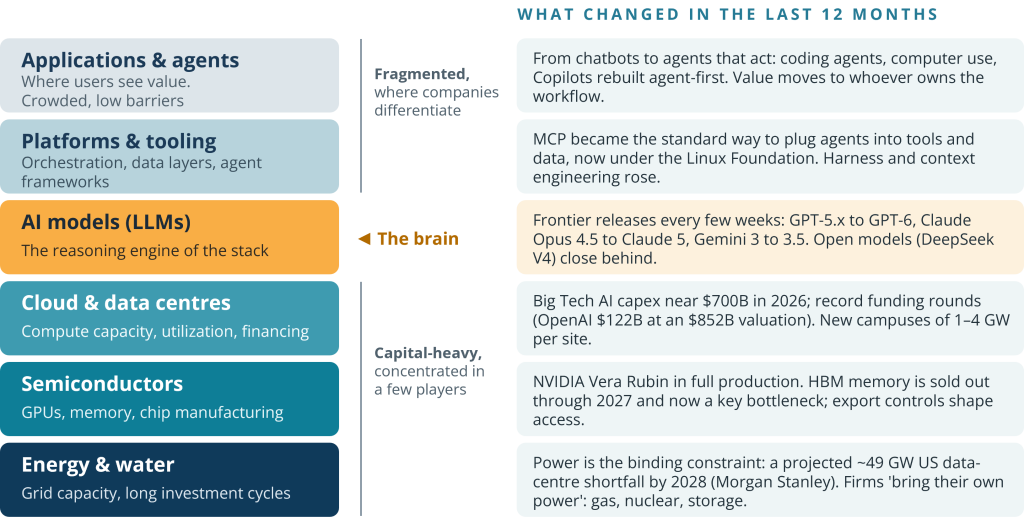
The supply side: six layers build AI capability, and all six moved this year
A new business model: agents change what is sold, and who buys
- Far more computing. Agents use far more computing than chatbots.
- From per user to per result. Pricing shifts from paying per user to paying per task or result.
- Cheaper means more. Falling AI prices are likely to increase total use rather than reduce spending.
What changed in agentic AI
- Longer running work. The earlier emphasis was on short tasks and frequent handoffs. Progress over the year has brought more sustained work across sessions, with preserved task state, recovery after interruptions, and more systematic verification. From November 2025 to April 2026, new approaches emerged for long-running agents and managed execution. [1]
- Richer tool & media use. The earlier emphasis was on document retrieval and basic tool calls. Agents now actively inspect and act, with more efficient tool access, code execution across connected tools, and targeted video, audio and image inspection. From November 2025 to September 2026, the developments included advanced tool use and agentic video inspection. [2]
- Broader coding tasks. The earlier emphasis was on code suggestions and individual fixes. Progress over the year has enabled agents to build, test and refine larger features, including longer implementation tasks, iterative testing and debugging, and greater scope for internal software. A 2026 survey reports that 32% forwent at least one software purchase because coding agents enabled an internal build. [3]
- Wider, more controlled deployment. The earlier emphasis was on pilot projects and custom setups, including isolated pilots. Progress over the year has brought more scaled and managed deployments, with monitoring and observability, human approval for sensitive actions, managed execution environments, stronger sandboxing and permissions, and greater attention to running costs. Among large-company survey respondents, the share scaling agents rose from 27% in 2025 to 40% in 2026. [3, 4]
The shift is towards longer tasks, richer tool use, broader coding scope, and more operational deployment. Capabilities existed before this period; the change is their maturity and adoption. Progress remains uneven.
[1] Anthropic Engineering, November 2025–April 2026.
[2] Anthropic, November 2025; Google DeepMind, September 2026.
[3] McKinsey State of AI, August 2026.
[4] Anthropic Managed Agents, April–May 2026.
Six layers turn capability into value
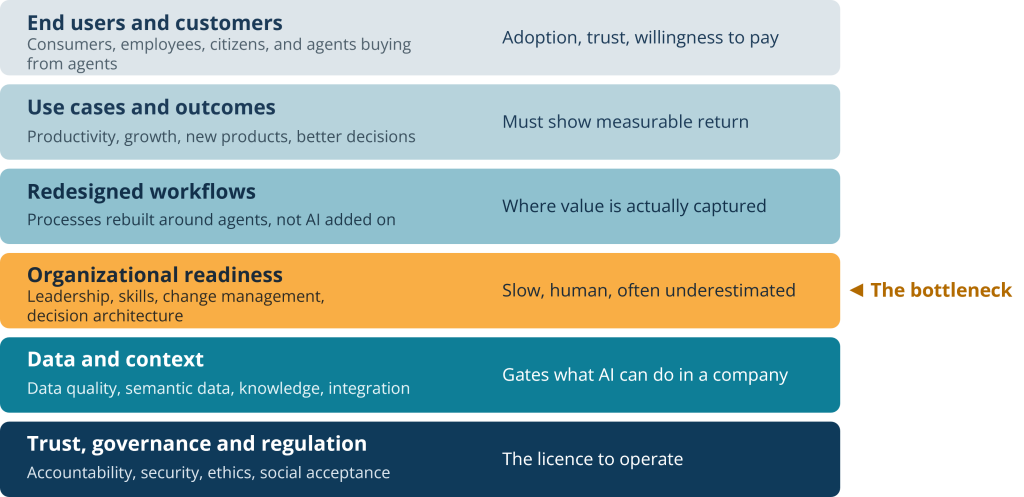
Capability is no longer the main constraint
What slows adoption is how fast organizations can absorb AI: redesign processes, retrain people and trust the results. AI is a leadership challenge.
Supply has the brain. Demand has the bottleneck
Supply is concentrated and capital-heavy, built by a few players with chips, power and data centres. Demand is fragmented and capability-heavy, created one organization and one workflow at a time. It depends on people, data and leadership more than on technology.
Four issues should be on top of the executive agenda
- Agent accountability. When an agent acts, who answers the outcome?
- Conversational interfaces and websites built for agents. Humans now ask instead of searching. Your next visitor, buyer or partner may be a machine.
- AI slop. Content is now cheap. Quality and trust are scarce.
- Overload, ROI and obsolescence. There are many new AI tools to use. Tools and skills now age in months, not years. How do I obtain real value from AI investments?
2. What are the implications for organizations?
Intelligence & execution is becoming cheap. Judgment is becoming scarce
We are all moving toward the augmented organization.
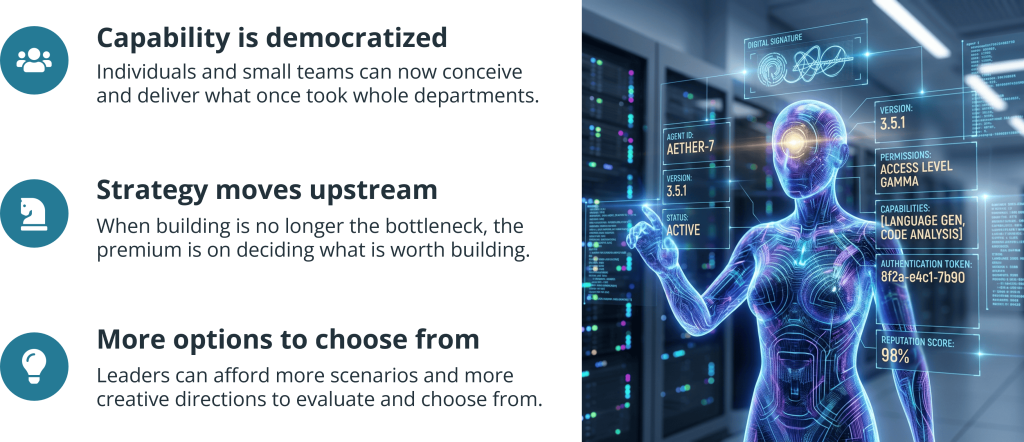
Human judgement is the scarce resource
In the industrial age, scarce resources were physical assets and production capacity. In the digital age, scarce resources were software, data, and the speed of replication. In the age of AI, the scarce resource is discernment. Artificial intelligence is producing results at a speed faster than human intelligence can validate on its own. The capacity for judgment is scarce.
As a result, most people who use AI are making mistakes more quickly. Unsustainable experimentation and “sloppy AI” are proliferating in companies.
People are producing more at a faster pace, reaching conclusions that have never been thoroughly examined. In most cases, humans aren’t making decisions. They’re rubber-stamping an algorithmic result under time pressure and with incomplete information. They’re putting a human signature on it without giving it much thought.
Where to look for competitive advantage
Top models are table stakes. Advantage lies elsewhere.
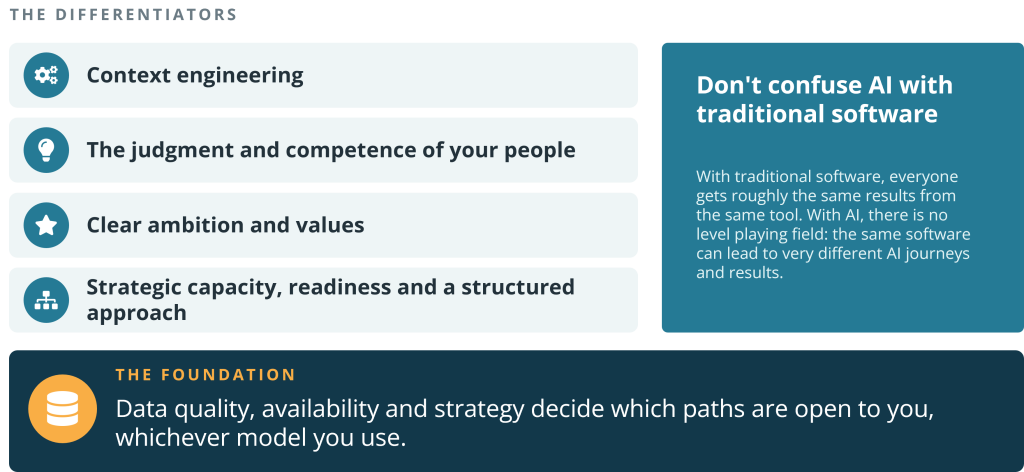
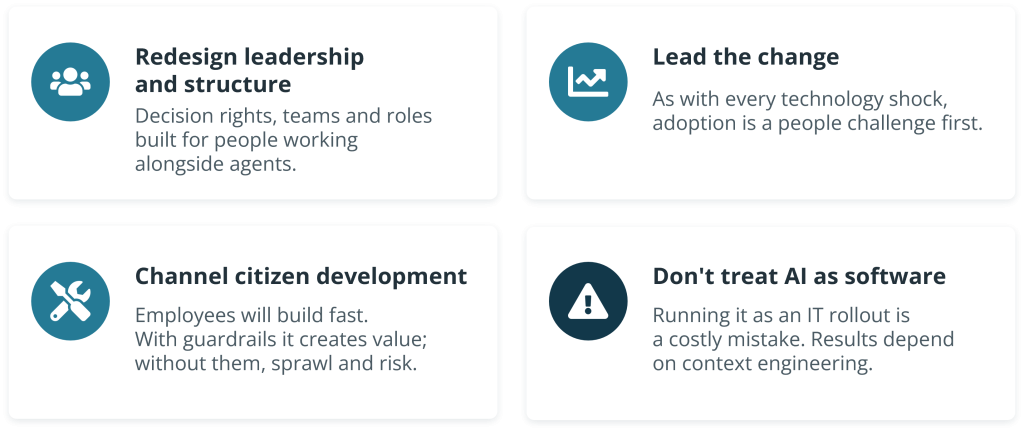
Four priorities for the organization
The new organizational structure: fewer layers, new building blocks
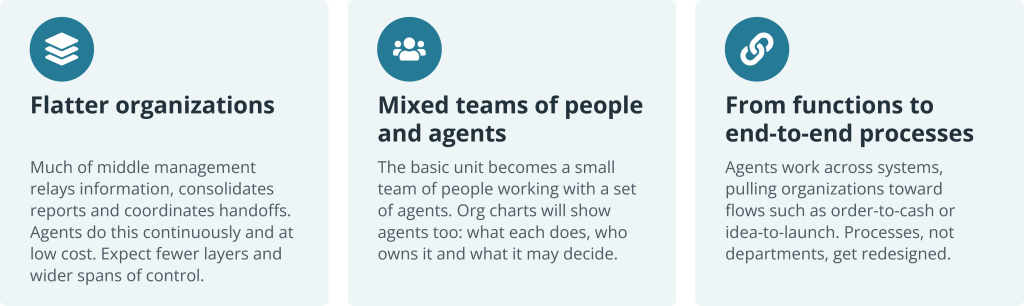
Smaller units, explicit control
Smaller organizations at the same scale. A team of 10 to 20 people with strong agents could run what once needed hundreds. Big companies will be pushed to act like collections of small, autonomous units.
New control functions. These include agent governance, a person accountable for each agent’s results, and teams that own the context agents work from. Every agent action needs a human owner.
Decision rights written down. For each decision, state who decides: the agent decides alone, the agent recommends, or a person decides.
Five effects to watch
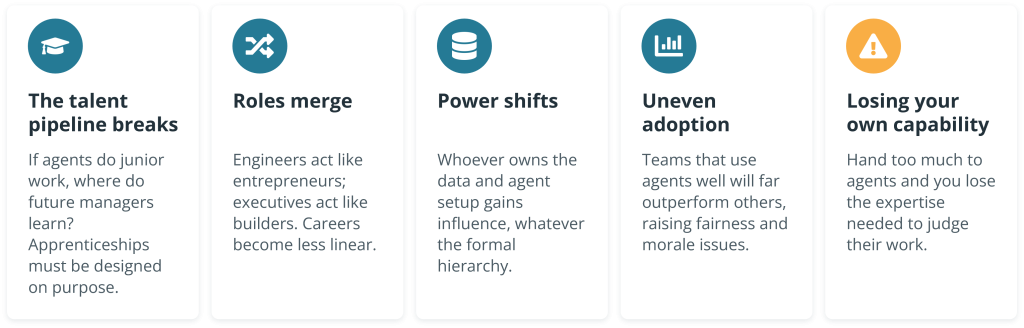
3. What are the implications for leaders?
AI is not a technical challenge. It is a leadership challenge
Leaders will evolve increasingly from decisionmakers to system designers of augmented organizations.
The companies that succeed with AI will not be those with the most advanced algorithms, but those with the strongest leadership alignment and the ability to turn AI into an everyday operational reality.
The focus is no longer having all the answers. It is now building organizations that learn and create value with AI faster than the competition.
Three factors make the paradigm shift profound
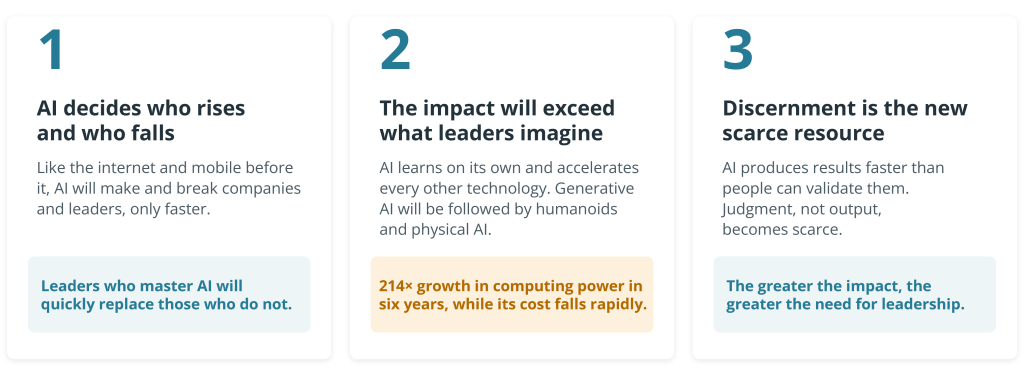
AI scales the quality of your thinking and organization
Apply trivial or average thinking and get average thinking and results at scale. Apply structured, advanced thinking and get advanced thinking and results at scale.

From command to context, from decisionmakers to system designers
Traditionally, leaders were valued for making high-quality decisions and guiding people in a direction. In the age of agentic AI, success depends on designing systems that consistently make good decisions.
Leaders must redesign how decisions are made, who makes them and what data drives them. The question is no longer “What decision should I make?” but “How should this decision be made going forward?”. The choices are to automate, improve or keep human led.
Leading with AI now means asking and directing
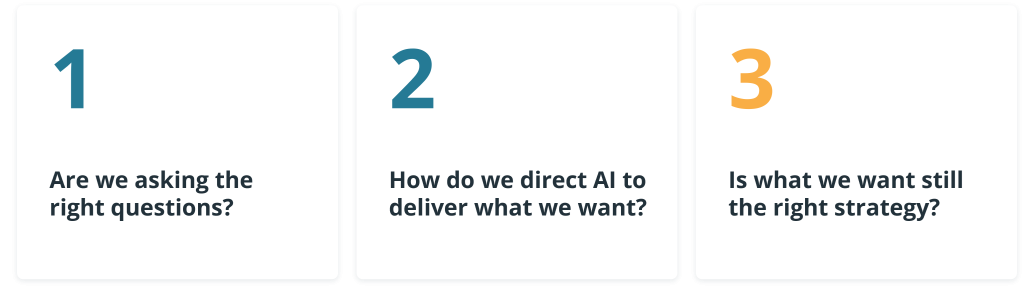
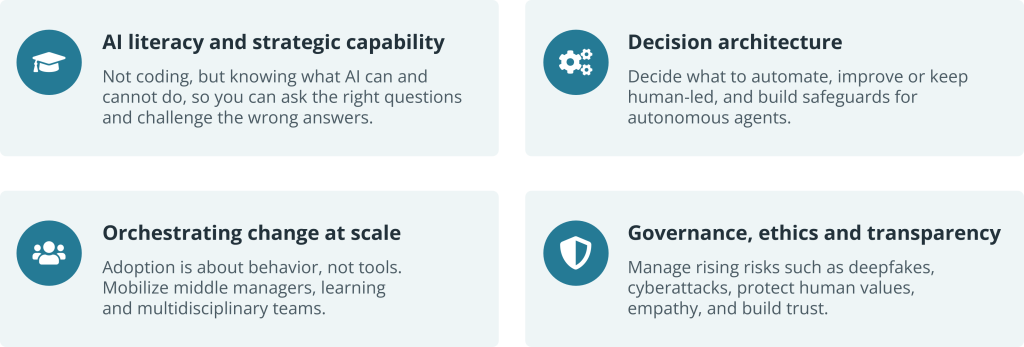
Every leader now needs four essential competencies
Top leadership: from deciding to designing
Designers of the system. The top team designs the system that decides: objectives, rules, data and safeguards.
Strategy is the bottleneck. Building is cheap. Clarity, values and stopping bad ideas early become the scarcest assets.
Strategy reviewed continuously. Rolling strategy replaces annual planning, without reacting to every signal.
Hands-on leaders. CEOs build prototypes themselves: closer to the work, but at risk of micromanaging.
New executive risks. These include liability for agents, errors at scale, cyber risk and boards asking where AI decides.
Culture and meaning. People look to leaders for purpose and fairness: who is retrained and how gains are shared.
Middle management is where the change is biggest: what fades, and what grows
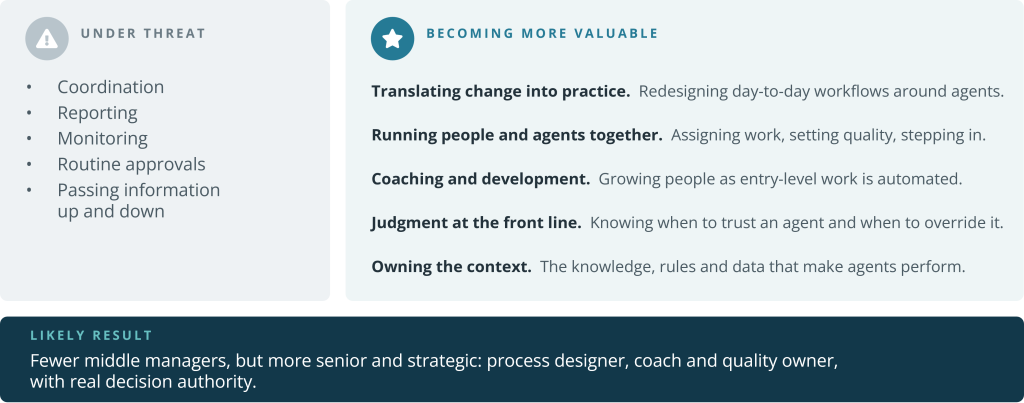
Roles are converging
Today’s AI engineer becomes a CEO running a team of agents. Today’s CEO or entrepreneur becomes a hands-on builder.
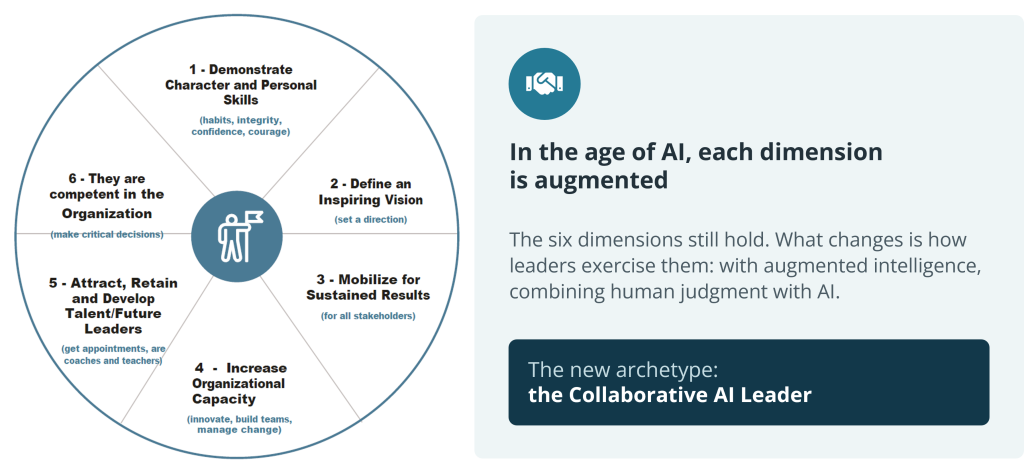
WHAT EFFECTIVE LEADERS DO
Six dimensions of effective leadership
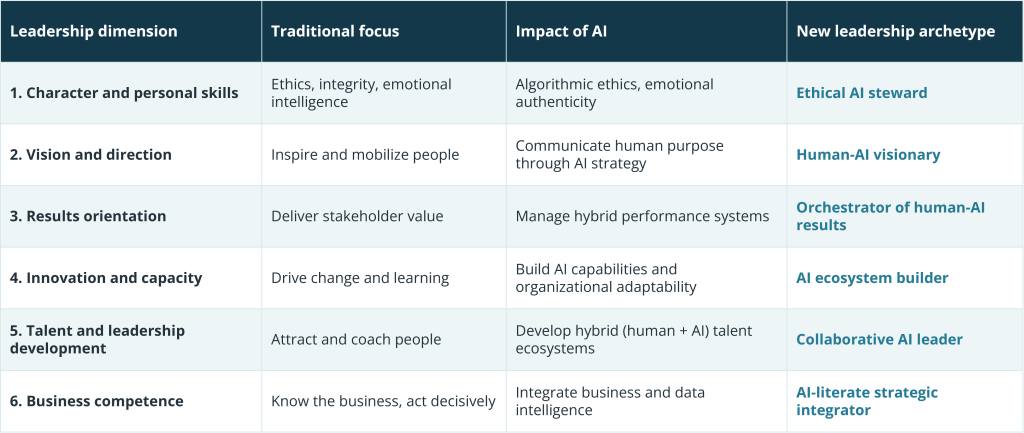
How AI changes each leadership dimension
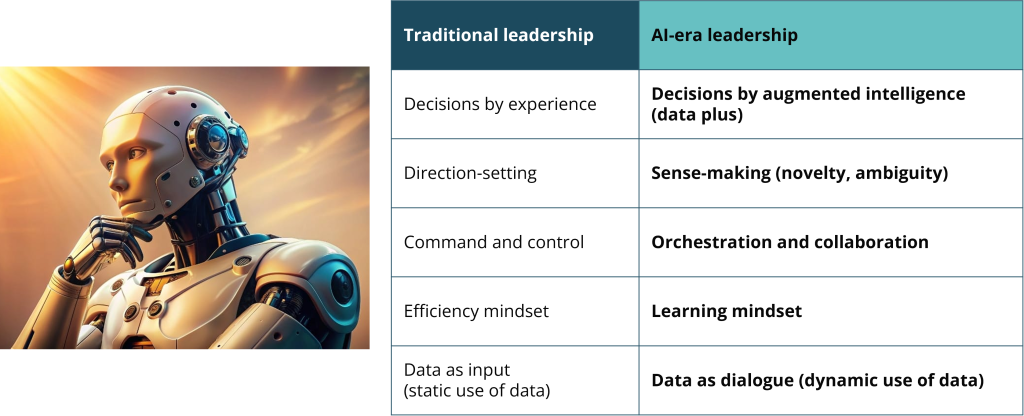
Which behaviors and assumptions you may need to change?
Almost anything can now be built.
Leadership is deciding what should be
4. How to best manage this disruption
Enterprise challenges: returns lag while technology races
The value gap: productivity is not profit. Gains are scattered: minutes saved per person rarely reach the P&L. Time saved becomes value only when work, roles and costs are redesigned. Costs are upfront and visible; returns are diffuse, delayed and often competed away.
Obsolescence: investments age in months. Models, tools and platforms leapfrog each other every few months. Today’s custom build can become tomorrow’s standard feature. Waiting is no answer: the cost of falling behind compounds.
What leaders can do is measure value in P&L terms, not hours saved; redesign workflows to bank the gains; build modular, model-agnostic architecture; and invest in what lasts: data, context and people.
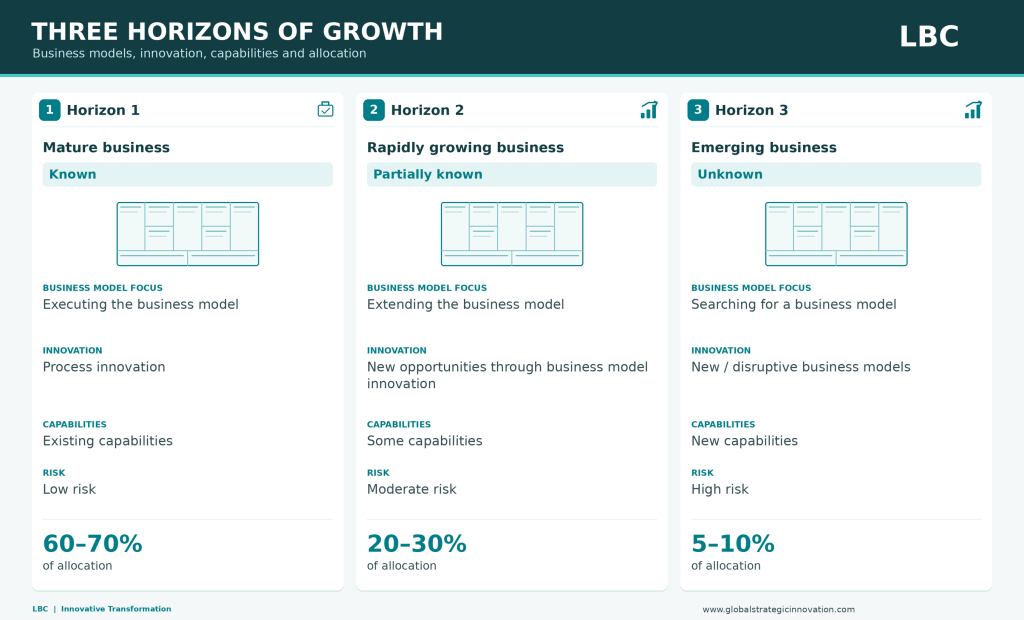
You need an innovation framework, such as Three Horizons of Growth
The Three Horizons of Growth framework covers business models, innovation, capabilities and allocation.
Horizon 1: Mature business – known. The business model focus is executing the business model. Innovation is process innovation, using existing capabilities and involving low risk. Allocation is 60–70%.
Horizon 2: Rapidly growing business – partially known. The business model focus is extending the business model. Innovation creates new opportunities through business model innovation, with some capabilities and moderate risk. Allocation is 20–30%.
Horizon 3: Emerging business – unknown. The business model focus is searching for a business model. Innovation concerns new or disruptive business models, requiring new capabilities and involving high risk. Allocation is 5–10%.
LBC | Innovative Transformation. www.globalstrategicinnovation.com
AI STRATEGY ROADMAP
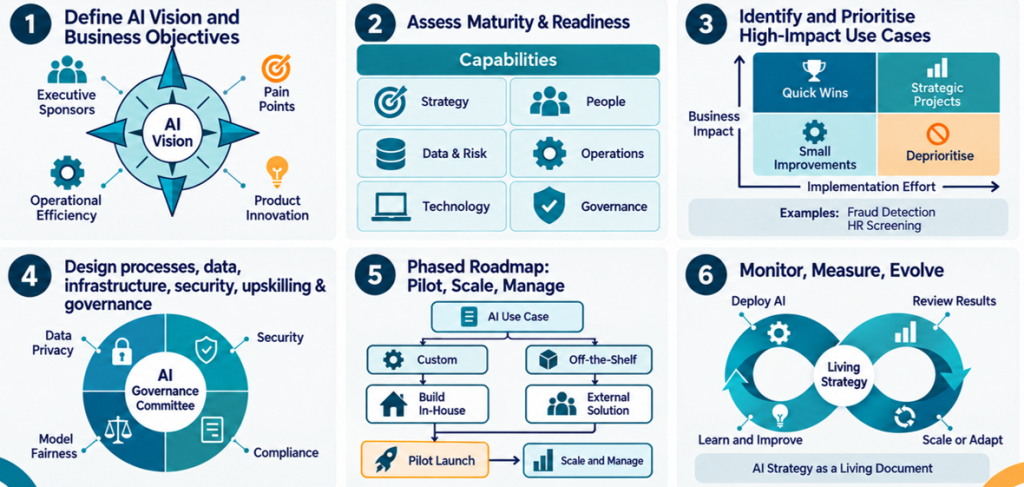
You need a structured strategy and roadmap to aim at exponential growth
- Define AI vision and business objectives. Establish the AI vision in relation to executive sponsors, pain points, operational efficiency and product innovation.
- Assess maturity & readiness. Assess six capabilities: strategy, people, data & risk, operations, technology and governance.
- Identify and prioritize high-impact use cases. Assess business impact against implementation effort. High-impact, lower-effort initiatives are quick wins; high-impact, higher-effort initiatives are strategic projects. Lower-impact, lower-effort initiatives are small improvements; lower-impact, higher-effort initiatives should be deprioritized. Examples include fraud detection and HR screening.
- Design processes, data, infrastructure, security, upskilling & governance. The AI Governance Committee covers data privacy, security, model fairness and compliance.
- Phased roadmap: pilot, scale, manage. For an AI use case, consider a custom solution built in-house or an off-the-shelf external solution. Move through pilot launch, then scale and manage.
- Monitor, measure, evolve. Maintain a living strategy through a cycle of deploying AI, reviewing results, scaling or adapting, and learning and improving. Treat AI strategy as a living document.
Five moves leaders need to make now
- Map key decisions. Assign each to an agent, agent plus person, or person only.
- Pilot one end-to-end process. Redesign it around agents, rather than adding agents to old tasks.
- Redefine the middle manager role. Train managers first: they carry the change.
- Set up agent governance early. Create an inventory of agents, a human owner for each, permissions and audits.
- Protect learning paths. Keep developing junior talent deliberately.
AI does not lead. People lead
Build augmented organizations that create exponential value with AI, where AI is the assistant and people are in control.
Click here to know more or book a metting.